My conversation with Henri Cartier-Bresson
An Imaginary Conversation About Seeing, Moving and Being Ready
If I could spend an afternoon with Henri Cartier-Bresson, I would not want to meet him in a photography studio. I would choose a small café somewhere in Paris. I would sit with him at a table near the window. His Leica would probably be somewhere within reach, but I suspect he would pay remarkably little attention to it. While I was considering my first question, his eyes would already be elsewhere. A man crossing the pavement. A reflection in a window. Two figures briefly overlapping. The sunlight drawing a diagonal across a wall. Watching. Always watching.
Cartier-Bresson repeatedly described himself as a visual person. Looking was not simply part of photography for him. It came before photography. He believed that learning to look required enormous time and that the photographer had to remain receptive to reality rather than arrive with a photograph already planned in his head. So if I had the opportunity to sit opposite him, I would not begin by asking what camera he used.
Q: “Henri, what exactly are you looking for?”
A: “I’m not looking for something specific. I’m looking for the moment when life, geometry and emotion suddenly come together. You cannot create that moment — you can only be ready to recognize it.”
Cartier-Bresson tried to approach situations without preconceived conclusions. He looked, listened and allowed reality to surprise him. The photographer, in his view, should not decide what something means and then search for a picture to prove it.
A fascination with geometry. His visual education had begun with painting. He studied with André Lhote and developed a fascination with geometry: lines, proportions, shapes and the organisation of space. But geometry alone was never enough. Structure provided the framework; life had to enter it.
Q: Henri, what motivates you to photograph?
A: “I photograph because I am curious about the world. Not to explain it, but to understand it by looking. On the street, nothing is completely under control. People move, meet each other, and disappear again. A gesture might last a fraction of a second. The light changes. Someone turns their head. Two forms that seem to have nothing to do with each other suddenly merge. That is what attracts me.
I walk. I look. I wait. Sometimes nothing happens for hours. But every now and then, you feel that all the elements in the image begin to move towards one another. The background, the people, the light, a posture, a glance. You don't know exactly what will happen yet, but you feel that something might emerge. Then I try not to intervene. I don't want to direct life. I want to be present with it.
The camera must almost disappear in the process. That is why I love a small camera and a simple lens. The less I have to think about the camera, the better I can look. And then comes that one moment when form and meaning coincide. You recognize it — and you press the shutter.” finished. A fraction of a second later, it no longer exists. Perhaps that is why I photograph: to extract that one fleeting moment from the flow of life before it is gone forever.”
Q: Henri, what were your reasons for going out to photograph? Did you go out because of an assignment, or did you just grab your Leica and hit the streets?
A: “Both. An assignment could give me a reason to be somewhere, but it could never tell me where the photograph was. Very often I simply walked. I have always been curious about people and about life. Photography gave me an excuse to look. I did not go into the street with a photograph already in my head. That would be dangerous. If you know beforehand what you want to photograph, you stop seeing what is actually happening. So I walked, I watched, and I remained available. Sometimes nothing happened. That was part of it.”
Q: Did you have fixed routes through Paris then?
A: “No. A route would become a habit, and habit is dangerous for the eye. Of course there were streets and neighbourhoods I knew well. But I preferred wandering. I followed curiosity. Perhaps I saw interesting light at the end of a street. Perhaps I followed someone for a little while. Perhaps I heard something around a corner. The city itself suggested where to go.”
Q: And did you go alone or with other photographers?
A: “Usually alone. Photography requires concentration. When you are with someone, you talk, you react to each other. When you are alone, you disappear into what is happening around you. I wanted to be unobtrusive. I didn't want people to become conscious of the photographer. The moment they become conscious of you, something changes.”
Q: Henri, when you walk down a street and there isn't a single photo yet — how do you deal with that?
A: “I don’t know that there will be a photo in ten seconds. I only feel that something is possible When I walk down a street, I don’t constantly look for subjects. I look at proportions. At a wall, an opening, a staircase, a shadow, at people moving and at the space between them. Sometimes I see a place where the composition actually already exists, but where something is still missing. Then I stay. Maybe it is an empty street with a beautiful diagonal shadow. Maybe a staircase whose lines lead my eye to one specific point. Maybe I see two people approaching each other. At that moment, I don’t have a photo yet. I only have a possibility. Next, I don’t just look at what is happening in front of me. I try to feel what might happen next.
Where are the people coming from? Where are they going? Where will two movements intersect? When will someone walk into the light spot? When will an arm, a leg, or a face appear in exactly the right place? You have to look ahead without wanting to control the moment. I might move half a meter to the left. A step back. A little closer. Not because there is a better photo there, but because I am trying to find the place where things might converge.
And when I have found that place, something important happens: I stop searching. Then I wait. I have more or less chosen the composition. Now I let life complete the image. Sometimes nothing happens. Then I walk on. That is part of photography. But sometimes someone comes around the corner. A child starts running. A cyclist appears. Someone looks back. Two people cross paths. And suddenly, for a fraction of a second, movement, form, and meaning coincide. At that moment, you must stop thinking. You must recognize. The photo does not come into existence when you press the shutter button. It began perhaps ten seconds earlier — when you saw that something could happen.”
Case Study 1 — Behind the Gare Saint-Lazare, Paris, 1932
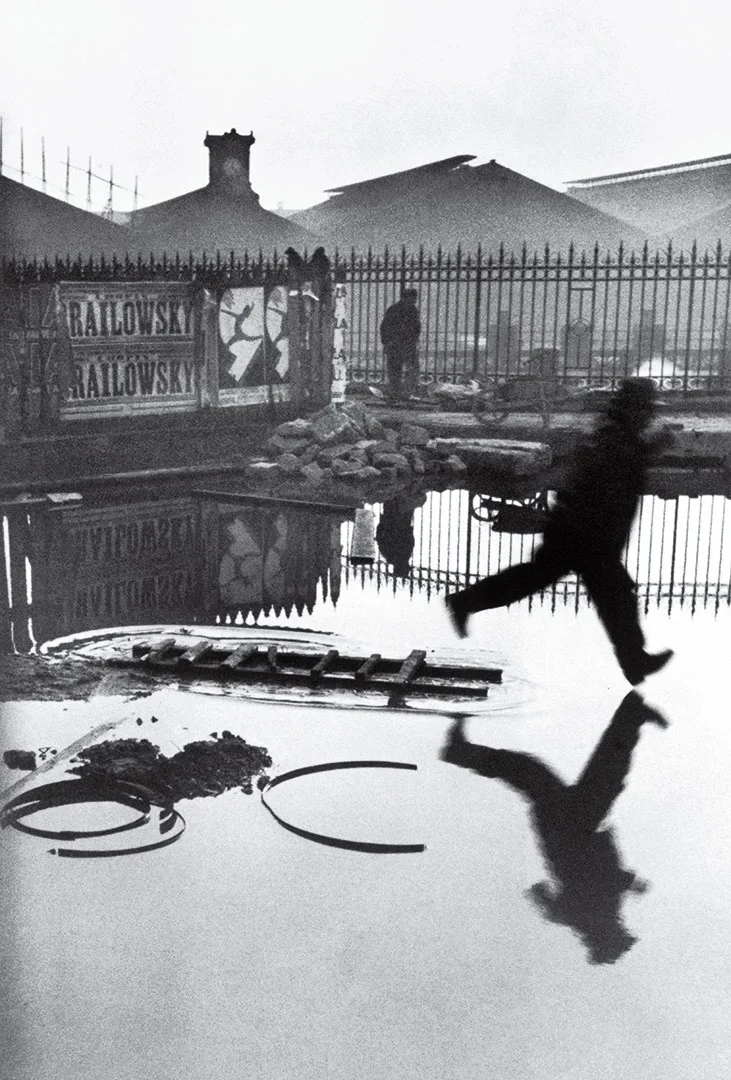
A man is suspended above a puddle. His foot has not yet touched the water and below him his reflection repeats the gesture. Behind him, another jumping figure appears on a poster. Everything depends upon a fraction of a second. Cartier-Bresson must first have recognized the visual possibilities of the location: water, reflections, fences, vertical structures and repeating shapes. Only then did the human figure complete the composition. Once his position was right, he probably needed to do very little. He waited. The world moved instead.
The exact lens and exposure for this photograph are not documented, so assigning settings such as f/8 and 1/125 second would be speculation. What matters is why he released the shutter. A moment later the man's foot would hit the water. The reflection would break and the tension would disappear. Here the decisive moment becomes almost literal: The photograph exists between what has just happened and what is about to happen.
Q: When did you not press the shutter button?
A: “Very often. Seeing something interesting is not enough. I don't photograph simply because something happens. Sometimes the light is right, but the composition is not. Sometimes the composition is perfect, but the gesture means nothing. Sometimes a person enters the frame, but one step too early — or one step too late. Then I don't photograph. You must not force the picture. Everything has to come together. Form, movement, expression, geometry — and something human that cannot quite be explained. If it isn't there, I wait. And sometimes I walk away without making a photograph.”
Q: How did people react when they noticed that you were photographing them?
A: “Most of the time, they didn't notice me. That was important. I did not want people to perform for the camera. The moment someone becomes aware of being photographed, the relationship changes. A face changes. A gesture changes. The natural rhythm disappears.
If someone did notice me, sometimes they looked at me, sometimes they smiled, sometimes they were curious. And occasionally, of course, someone did not want to be photographed. Then you must respect that. A photograph is never worth destroying the dignity of the person in front of you.
Not everyone wishes to be photographed. If someone objected, I had no reason to argue. I was interested in observing life, not in creating a confrontation. Sometimes a smile or a few words were enough. If someone really objected, I moved on. There are photographs everywhere. Why fight over one?”
“The photograph may belong to you. The moment belonged to both of you.”
How Did He Move?
If I could leave that Paris café with Cartier-Bresson, I would put my own camera away for a while. I would simply watch him walk. Cartier-Bresson believed a photographer should not rush. Walking was part of his photographic method: observe, stop, move a little, wait, move again. He compared his movement around a subject to someone following a boxing match. Small movements could completely alter the relationship between foreground and background.
People who watched him work described him creeping, moving on tiptoe, approaching and withdrawing. If someone became too aware of his presence, he might look elsewhere and wait until normal behaviour returned. That physical relationship with the scene becomes particularly clear in another photograph.
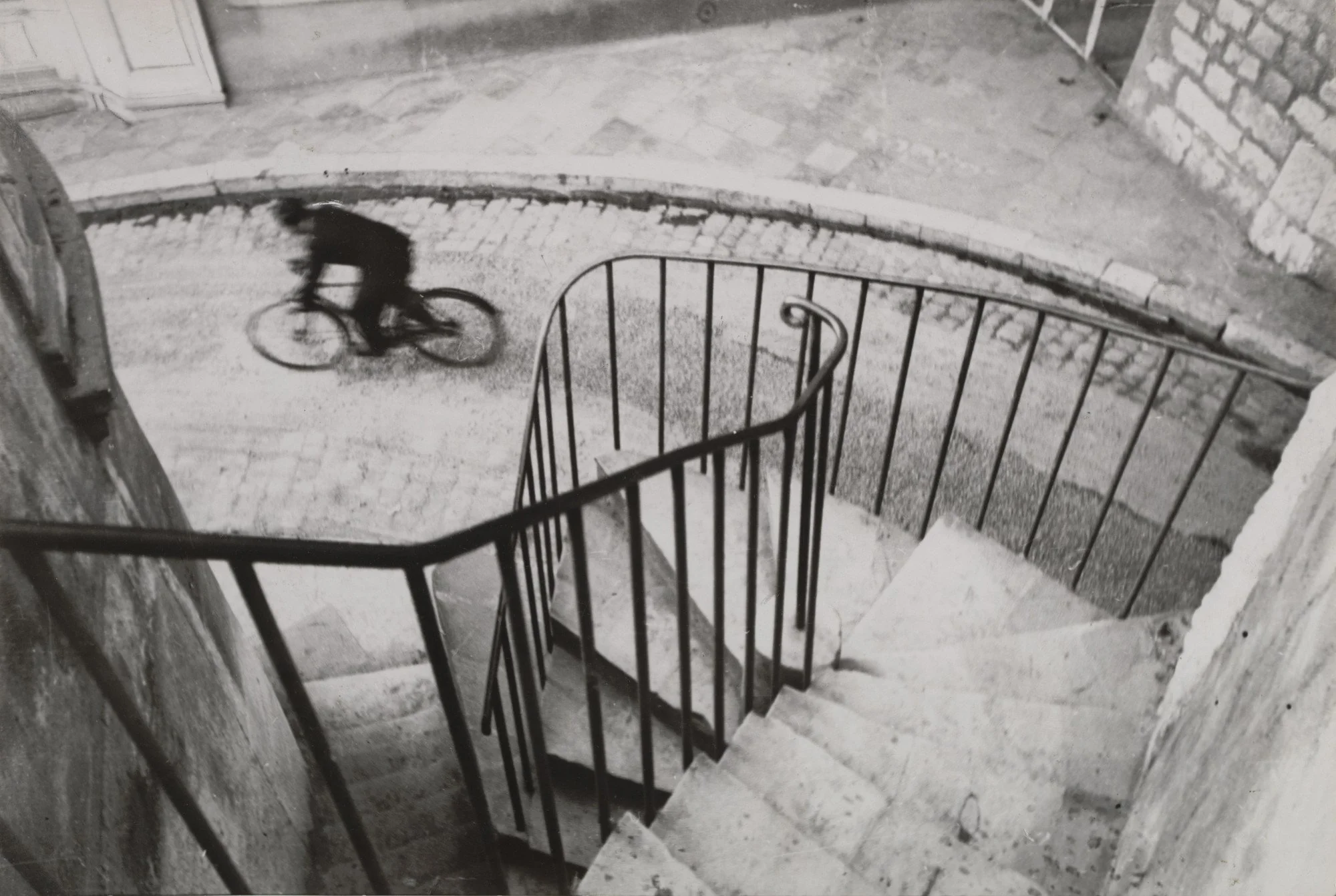
Case Study 2 — Hyères, France, 1932
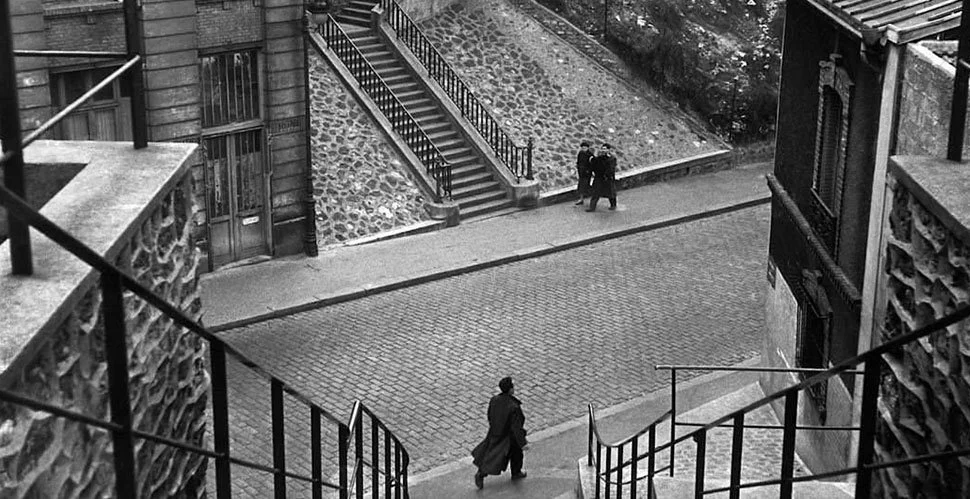
We look down from a staircase. A curved railing dominates the foreground while a cyclist passes through the street below. I suspect the cyclist was not what Cartier-Bresson noticed first. The staircase was. The curve, the railing and the rectangular pavement already formed a stage. He needed to find the position from which those elements worked together. Then he waited. The cyclist became the actor entering a stage that already existed.
The exact focal length and exposure are again undocumented. But technically the most important decision probably happened before the cyclist appeared: prepare the frame and let life enter it. A fraction earlier the cyclist would have been too far left; a fraction later he would have disappeared. The architecture provides structure. The cyclist provides time. The photograph exists where geometry meets movement.
Q: Henri, tell me about the Leica.
A: “The Leica? It is not important. And that is precisely why it is important.
A camera should never stand between you and what is happening in front of you. I don't want to think about equipment when I photograph. I want to look. The Leica is small. Quiet. Discreet. I can carry it all day and almost forget that it is there. People forget about it too. That matters enormously. With a large camera, you announce yourself as a photographer. With the Leica, I can remain an observer. I raise it to my eye only when necessary. I don't want the camera to change what is happening in front of me.
And I don't need many lenses. Give me a 50mm and I can photograph almost everything I need. It corresponds naturally with the way I see. I don't want the lens to create the photograph for me. Nor do I want to stand somewhere turning rings and thinking about settings while life continues without me. So I prepare. I know approximately where my focus is. I understand the light. I know my exposure. Much of this is decided before anything interesting happens. Then I can forget about the camera.
When something begins to develop, my attention is not on aperture or shutter speed. It is on the relationship between things: a person approaching, another leaving, a shadow, a gesture, the geometry of the street. The Leica simply waits with me. And when everything comes together for that fraction of a second… click. Then it disappears again.”
Q: But Henri, surely the camera matters?
A: “Of course it matters. A violin matters to a violinist. But nobody goes to a concert to admire the violin.”
That isn't an authentic Cartier-Bresson quotation either, but it captures an important aspect of his attitude toward equipment. He famously became closely associated with the 35mm Leica rangefinder, often working with a 50mm lens. The compact camera allowed him to move quickly and unobtrusively. He was also known for making the shiny parts of his Leica less conspicuous. But there is something deeper here that I think is especially relevant to understanding him. Cartier-Bresson's Leica wasn't merely small. It changed the rhythm of photographing."
Case Study 3 — Juvisy, France, 1938
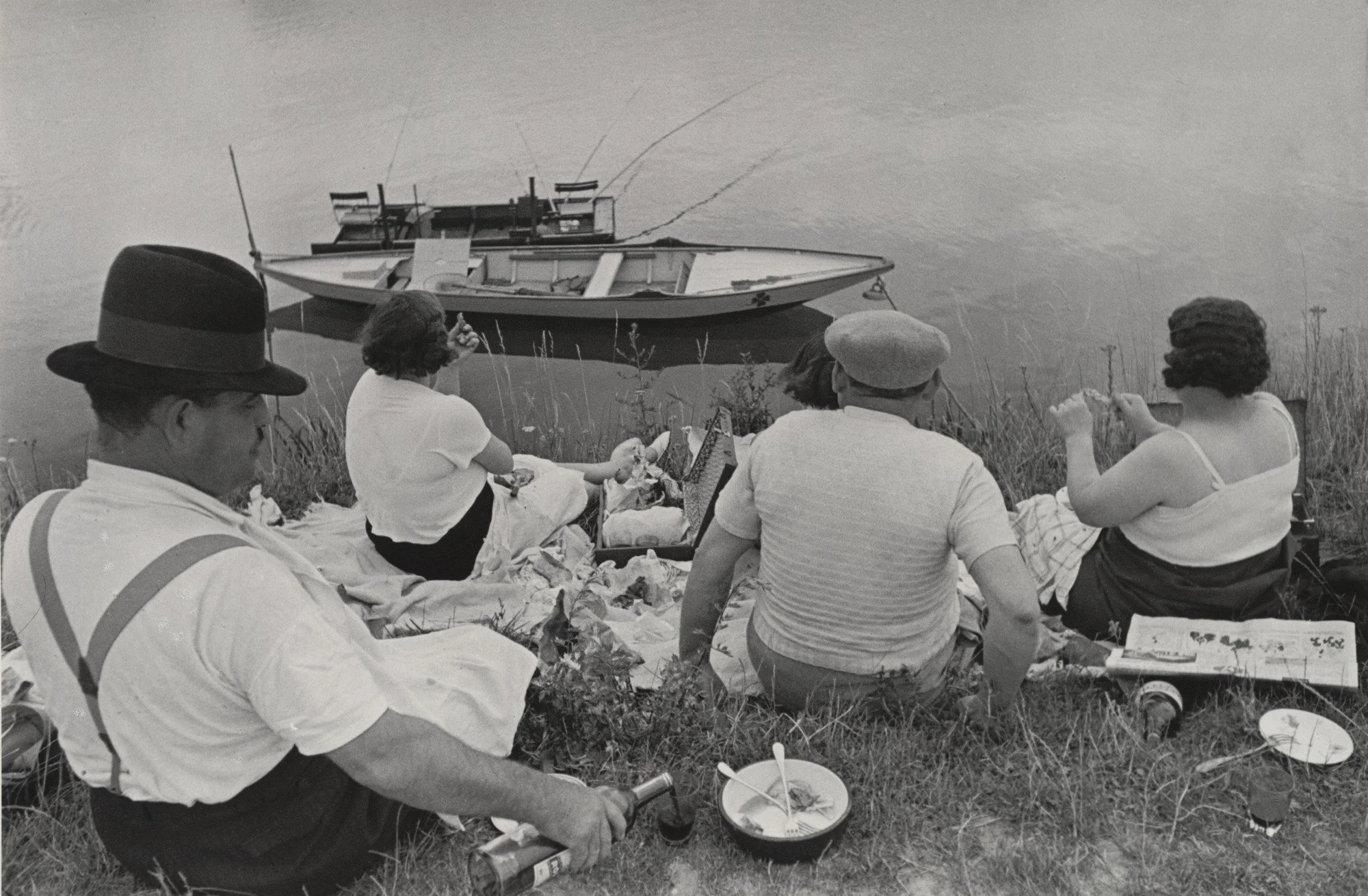
A small group sits beside the water. Food, wine, conversation and leisure. Nothing spectacular is happening, and that is precisely what makes the photograph interesting. Cartier-Bresson was fascinated by ordinary human life. He did not want to isolate people from their surroundings; the environment was part of their story. Here he stays close enough for us to feel part of the gathering while retaining enough distance to show where these people are. And unusually, we know something about his lens choice: when asked about this photograph, Cartier-Bresson remembered using a wide-angle lens. That is revealing because wide angles were not normally his preference.
It suggests a simple principle: subject first, composition second, equipment follows. The decisive moment here is also much quieter than at Saint-Lazare. There is no dramatic action. It is simply the instant when posture, people and environment settle into a visual relationship that feels complete. The decisive moment does not always shout. Sometimes it whispers.
The Camera Was Ready Before the Photographs
Cartier-Bresson becomes surprisingly practical when discussing how he prepared his Leica. In a 1952 conversation he explained that while walking he often kept his camera approximately set to: f/8–f/11 · 1/100 second · focus around 3 meters. These were not magical settings. They were a state of readiness. With sufficient depth of field, he could react immediately when something unexpected happened. This is perhaps one of the most useful things we can learn from him. His technique was not about adjusting the camera quickly. It was about preparing the camera so he didn't have to. And yet he never wanted technique to become a formula. Camera operation had to become instinctive, leaving his attention free for what was happening in front of him.
Case Study 4 — Rue Mouffetard, Paris, 1954
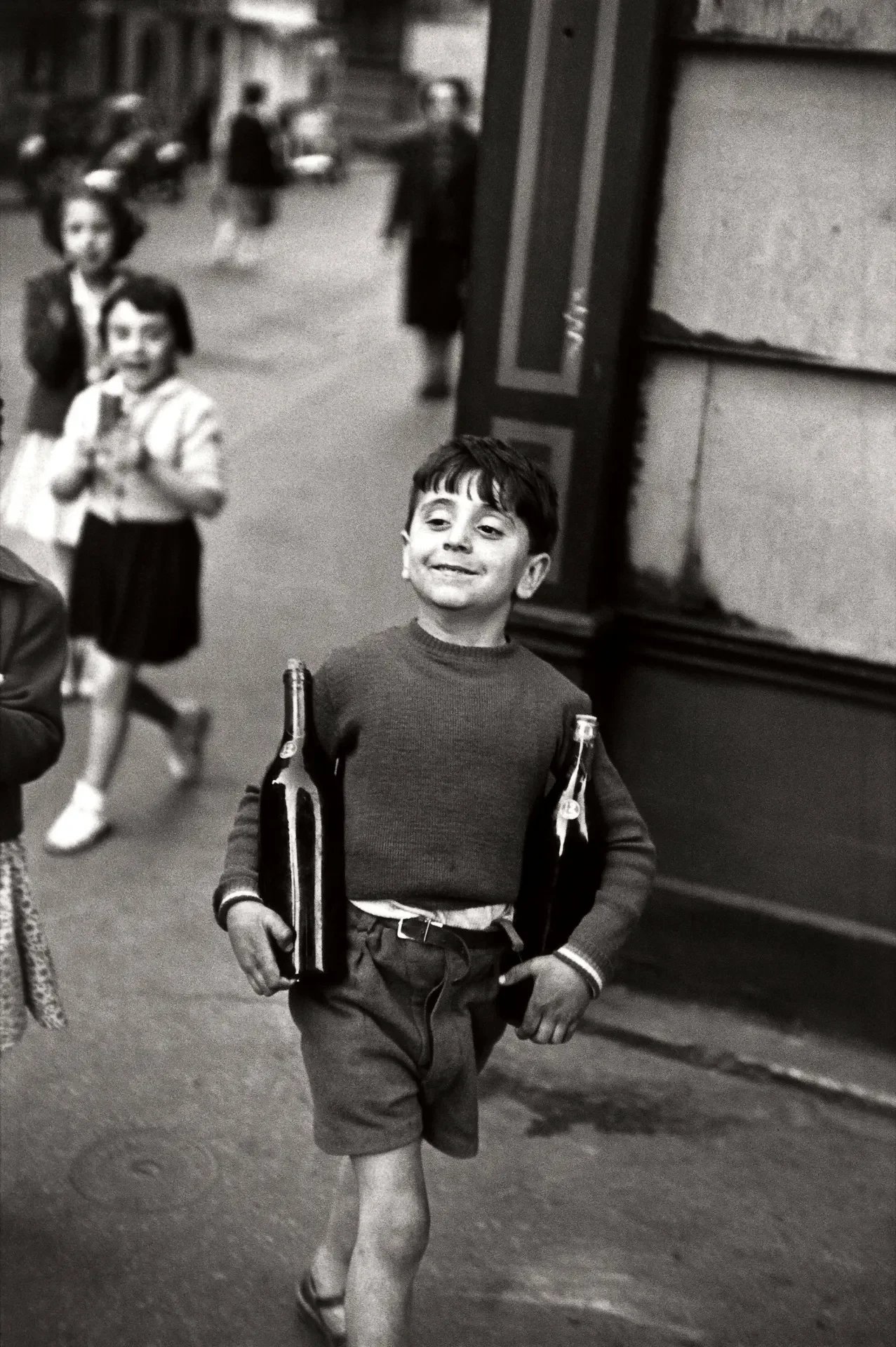
Seeing Human Behaviour.
Sometimes the decisive moment simply walks towards you. A young boy comes down the Rue Mouffetard carrying two large bottles, one proudly tucked beneath each arm. His shoulders are raised, his chest pushed forward and his expression contains a wonderful mixture of pride, confidence and mischief. Behind him, two girls appear amused. An ordinary errand has suddenly become a small human performance.
This photograph is less about geometry than human behaviour. Cartier-Bresson seems to have been relatively close to the boy. We are inside the event rather than observing it from a distance. The boy may even have been aware of the photographer. But being noticed does not automatically make a photograph staged. There is a difference between someone noticing a camera and the photographer directing what happens. Perhaps the boy's awareness even strengthened his little performance.
Unlike Hyères, the sequence may therefore have been reversed. There, Cartier-Bresson found the stage and waited for an actor. Here, he first noticed the boy and then immediately recognised the photograph. We don't know the exact lens or exposure. A 50mm would be consistent with his normal practice, but that remains an assumption. More important is that his camera was ready before he knew what would appear.
Why this exact moment? The boy's face is fully visible. One leg moves forward. The bottles frame his small body and his expression has reached its peak.
Cartier-Bresson chose the instant in which gesture and personality coincide. And the girls behind him matter too. They become an audience and add a second layer to the story. This photograph teaches me something important: Don't become so obsessed with perfect composition that you stop seeing people. Sometimes the photograph is found in character, expression and interaction.
It’s al about the ontact sheets.
Cartier-Bresson believed that contact sheets reveal the photographer's thinking. Approach - Correct the position - Look again - Move slightly - Another frame. Eventually the relationships come together. He compared the process to positioning a nail with several small taps before delivering the final blow. That makes the decisive moment less mysterious. Intuition matters, but it is supported by preparation. And nowhere is that more apparent than in a very different photograph.
Q: What tip would you give to street photographers?
A: “Look at paintings. Don't look only at photographs. Study how painters organize space. Look at where they place a figure. Look at the empty spaces. Look at diagonals, repetition, balance. Then forget all of it when you go into the street. Because when life suddenly appears in front of you, there is no time to calculate.”
Case Study 5 — Dessau, Germany, 1945
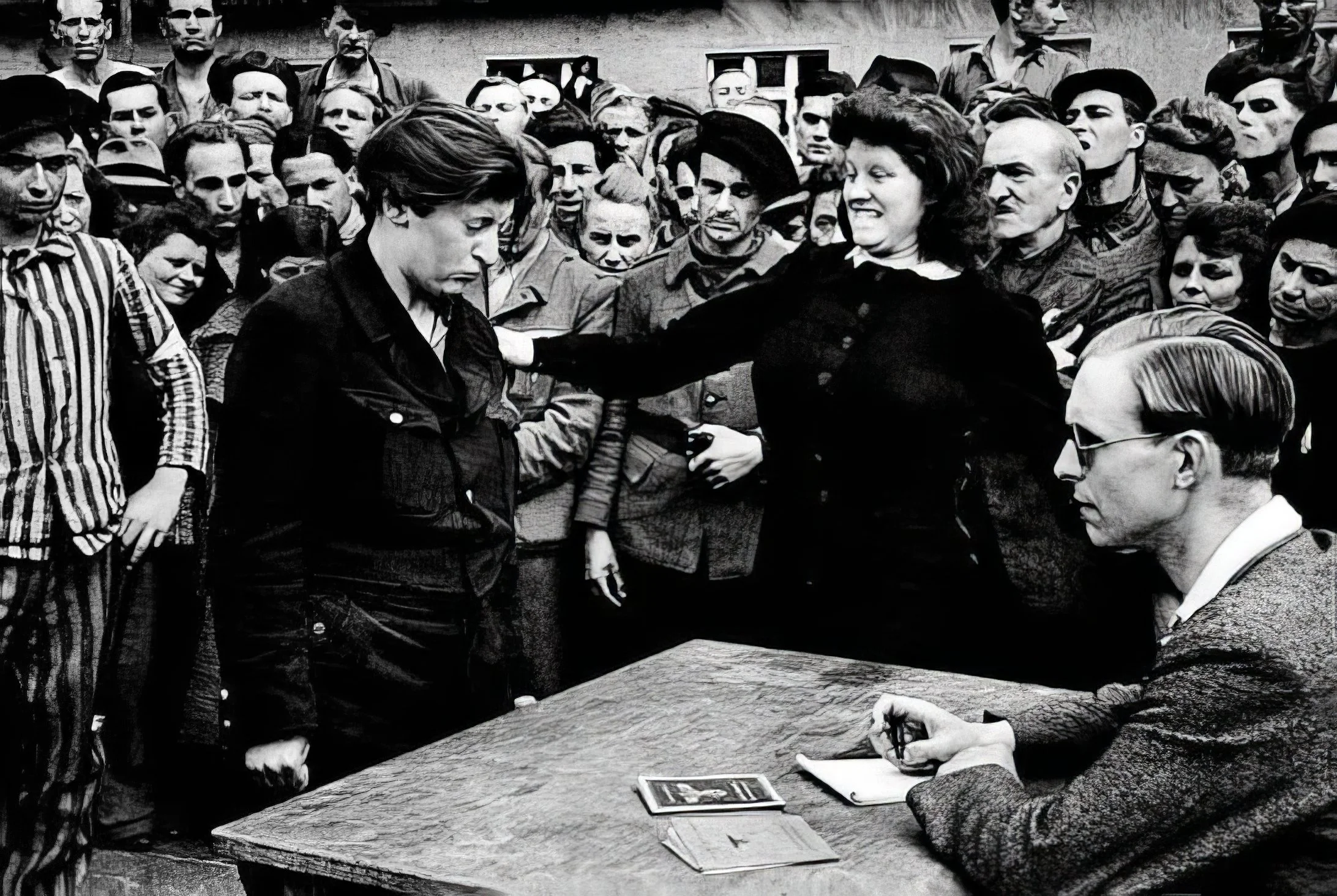
Not every decisive moment is poetic. In Dessau in 1945, Cartier-Bresson photographed a confrontation in a transit camp. A woman identified as a former Gestapo informer stands with her head lowered while another woman confronts her. An official sits behind a table and a dense crowd watches. The historical context gives every gesture weight. But look beyond the event itself. The accused woman stands slightly left of centre. The accuser reaches towards her. The seated man anchors the foreground, while behind them a semicircle of faces almost closes the composition. The crowd isn't background.
The crowd is part of the story. Cartier-Bresson had positioned himself close enough to capture the confrontation but far enough away to retain the reactions surrounding it. And then comes the crucial gesture. The accuser's arm reaches across the frame while the other woman's body seems to collapse inward. One expands. The other contracts. Movement against stillness. Accusation against submission.
A second earlier, the gesture would have been incomplete. A second later, the relationship might have disappeared. Here the decisive moment becomes the decisive gesture. This photograph teaches a different lesson: don't photograph only the obvious action. Watch hands, shoulders, faces, distances. And especially the people surrounding the main event. Often the real story exists in the relationship between people.
What Did These Five Photographs Teach Me?
Looking at these five photographs together changes my understanding of the decisive moment. It is not one technique. Each photograph asks something different from the photographer:
Saint-Lazare — decisive timing
Recognise when movement reaches its visual peak.Hyères — decisive placement
Find the composition first and allow life to enter it.Juvisy — decisive relationship
See people as part of their environment.Rue Mouffetard — decisive expression
Recognise character and human behaviour before they disappear.Dessau — decisive gesture
Watch how gestures and reactions reveal the meaning of an event.
That, perhaps, is why Cartier-Bresson's photographs feel so different while still unmistakably belonging to the same photographer. He did not impose one visual formula on reality. He responded to what reality gave him.
What Would Cartier-Bresson Do Today?
Now I remove the Leica from our imaginary café table and replace it with a modern camera: Fujifilm X-Pro2 + XF 35mm f/2. Would Cartier-Bresson actually use one? We cannot know. But that isn't really the point. The interesting question is how we can use modern technology according to his principles. A 35mm lens on the X-Pro2 gives approximately the field of view of a 50mm lens on 35mm film. More importantly, the camera can be configured so that technology largely disappears.
My Cartier-Bresson-Inspired Setup
Fujifilm X-Pro2 + 35mm f/2
Aperture: f/8
Exposure: Manual
ISO: Auto ISO
Minimum shutter: 1/250 sec
Focus: Manual, around 3 metres as a starting point
Drive: Single frame
File: RAW + JPEG
Preview: ACROS
I am not trying to copy his technology. I am copying his preparedness. At f/8, depth of field gives me room. Instead of constantly thinking about autofocus points, I can decide where I expect something to happen, focus there and watch. Auto ISO is something Cartier-Bresson never had, but I think it suits his philosophy perfectly. Once aperture and minimum shutter speed are chosen, the camera can respond to changing light while my attention remains on the street. And instead of his approximately 1/100 second, I would start around 1/250 second. Modern digital ISO gives us that freedom. The precise numbers aren't the lesson. Being ready is.
A Cartier-Bresson Exercise
There is a simple exercise I would take into the street. One camera - One lens - One hour. No lens changes and no high-speed burst. And for the first fifteen minutes: no photographs. Just walk and look. Search for a stage before searching for an actor. A staircase. A reflection. A shaft of sunlight. A doorway. A geometric relationship. Or forget geometry for a moment and watch people. A gesture. A glance. Someone proudly carrying something. Two strangers reacting to each other.
When something begins to develop, ask yourself: What is happening now? And then the more important question: What might happen one second from now? Prepare the camera. Move slightly if necessary. Wait. And when gesture, expression, geometry and meaning briefly come together: Click.
The Photograph Before the Photograph
Back at our imaginary café table, I realise that my original question was wrong. I wanted to know how Cartier-Bresson took his photographs. The more interesting question is: What happened before he took them? He looked - He walked - He recognised geometry and human behaviour - He changed position - He understood the light - He prepared his camera - And he waited.
Only when gesture, meaning, space and time briefly came together did he press the shutter. Your original text ends with exactly that idea: the famous phrase the decisive moment can mislead us into thinking only about the final fraction of a second, while the photograph actually begins much earlier.
Perhaps that is the lesson I would take home after my imaginary afternoon with Henri Cartier-Bresson:
The decisive moment may last only a fraction of a second. But learning to see it can take a lifetime.