
My Canon camera gear
For me, the Canon EOS system is about speed, reliability and complete confidence in my equipment. It allows me to concentrate entirely on the moment, knowing the camera will respond instantly and precisely when the action unfolds.
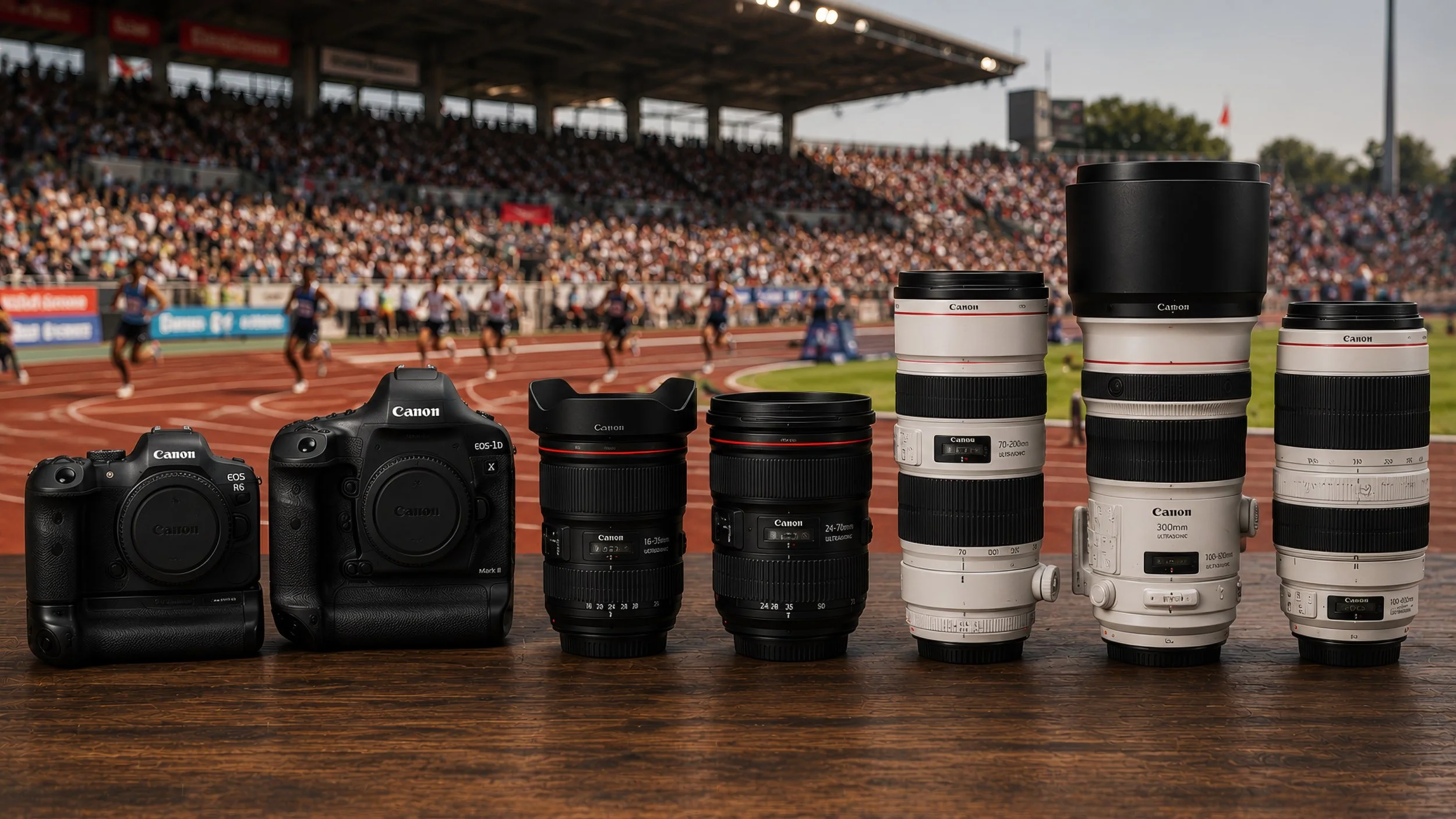
I regularly get asked questions about my photography gear. That is the reason I’ve compiled a list of my Canon photography kit. I don’t usually emphasize the gear aspect of my photography, but I hope this is helpful to someone. I am not sponsored. All my gear was acquired with my own funds.
With my Canon EOS EOS R6, EOS-1D X Mark II and EOS-1D X, I have cameras that are built to respond instantly when the moment matters.
Especially in my fine art sports photography, I need a camera that allows me to concentrate on what is happening in front of me rather than on the technology in my hands. Canon gives me that confidence. The responsive autofocus, intuitive controls and excellent ergonomics make the cameras feel like natural extensions of the way I work.
Where my Fujifilm cameras often invite me to slow down and observe, my Canon bodies encourage me to react, anticipate and follow the action. Combined with fast professional lenses, they give me the flexibility to move from a wider storytelling image to a tightly framed moment of emotion or intensity within seconds.
I can follow unpredictable movement, respond to changing light and capture those fractions of a second that can never be repeated. Yet speed is never the goal itself — it is simply what gives me the freedom to concentrate on timing, emotion and storytelling.
Canon gives me something essential in my professional photography: the confidence to forget about the camera and concentrate completely on the moment.
Canon EOS R6
The Canon EOS R6 is a camera I turn to when speed, precision and reliability really matter. Its responsive autofocus and excellent subject tracking allow me to concentrate on what is happening in front of me rather than on the technical process of capturing it. Especially in sports photography, events and fast-moving documentary situations, that confidence makes a real difference.
What I appreciate most about the R6 is the way it combines speed with control. It reacts instantly when a moment develops, performs extremely well in challenging light and gives me the freedom to follow movement without losing connection with the scene. Combined with Canon’s professional lenses, it becomes a dependable working tool that feels equally at home beside a sports field, during an event or in the middle of a documentary assignment.
For me, the EOS R6 is less about slowing down and more about being ready when the moment happens. When there is only a fraction of a second to respond, I want a camera I can trust — and that is exactly where the R6 excels.
Canon BG-R10 battery grip
The Canon BG-R10 Battery Grip is an accessory I mainly use when working for longer periods with my Canon EOS R6 cameras. It accommodates two LP-E6 series batteries, providing significantly more shooting time without having to interrupt a session to change batteries.
For sports, events and assignments where I may be photographing continuously for several hours, that extra capacity is particularly useful. It allows me to concentrate on what is happening in front of the camera rather than constantly keeping an eye on battery levels.
Another important advantage is handling. The BG-R10 provides additional controls for vertical shooting, including a shutter button and control dials. This makes switching between horizontal and vertical compositions much more natural, especially when photographing portraits, athletes or award ceremonies.
The additional size and weight also improve the balance of the camera when using larger EF lenses through the Canon EF–RF adapter, such as my 70–200mm f/2.8 or 300mm f/2.8.
Canon 1Dx Mii
The Canon EOS-1D X Mark II is a camera built for situations where there is little room for hesitation. Its speed, robust construction and dependable autofocus make it particularly suited to sports photography, action and demanding professional assignments, where capturing the right fraction of a second can make all the difference.
What I value most about the 1D X Mark II is its sense of absolute reliability. The camera feels incredibly solid in my hands, responds instantly and allows me to follow unpredictable movement with confidence. Combined with Canon’s professional telephoto lenses, its ergonomics and responsiveness make it a natural tool for working alongside a sports field or in other fast-moving environments.
For me, the 1D X Mark II represents a different philosophy from a smaller, more discreet camera. It is not designed to disappear — it is designed to perform. When speed, timing and consistency are essential, I want a camera that simply keeps up with what is happening in front of me. The 1D X Mark II still gives me exactly that confidence.
Canon 1Dx
The Canon EOS-1D X is my back-up camera. It was clearly designed with professional action photography in mind. Its combination of speed, rugged construction and responsive autofocus makes it a camera I can rely on when photographing sports, events and fast-moving situations, where timing is everything.
What I particularly appreciate about the 1D X is its direct and purposeful character. It feels substantial in my hands, the controls fall naturally into place and the camera responds without getting in the way of the moment. Combined with Canon’s professional lenses, it gives me the confidence to concentrate on movement, anticipation and composition rather than worrying about the equipment.
For me, the EOS-1D X represents photography where reaction and anticipation come together. In sports photography especially, you often see the moment developing before it actually happens. The camera needs to be ready when you are. Even today, the 1D X remains a remarkably capable photographic tool — built to work hard, react quickly and capture those moments that exist for only a fraction of a second.
Lenses for my Canon camera’s
For me, choosing a lens is not simply about focal length, sharpness or technical perfection — it is about deciding how I want to experience and translate the scene in front of me. My Canon lenses give me the freedom to move between very different photographic situations, from fast-moving sports and documentary assignments to portraits, details and quieter observations.
What I value most about Canon lenses is their combination of optical quality, speed and reliability. When a moment lasts only a fraction of a second, I need equipment that responds instinctively with me. Fast and accurate autofocus allows me to concentrate on timing, movement and composition rather than on the technology in my hands.
Different focal lengths also change the way I approach a subject. A wide-angle lens encourages me to step closer and include the surroundings, allowing people, sport stadiums and atmosphere to become part of the story. A longer lens creates distance, isolates moments and lets me observe without disturbing what is unfolding. A fast prime, meanwhile, invites me to work more deliberately with light, depth and visual simplicity.
I don't see my lenses simply as a collection covering different focal lengths. Each one offers a different way of seeing and influences where I stand, how I move and what I choose to include — or leave outside the frame.
Some lenses help me react instantly to unpredictable action, while others allow me to simplify a scene, isolate a gesture or discover a more intimate perspective. Together, they give me the flexibility to adapt my visual language to the story in front of me.
The camera captures the moment, but the lens determines the perspective from which I choose to tell the story.
Canon 16-35mm F2.8
The Canon EF 16–35mm f/2.8L III USM is one of my most versatile choices when I want to combine a strong sense of place, perspective and human presence. Its wide field of view allows me to include more of the environment while still keeping people and action at the heart of the photograph.
What I particularly enjoy is the freedom to move between the dramatic perspective of 16mm and the more natural, documentary feel of 35mm. Combined with its constant f/2.8 aperture, fast autofocus and excellent optical quality, it gives me the confidence to work quickly in changing light and unpredictable situations.
I often use this lens when I want to step closer rather than photograph from a distance. At the wider focal lengths, perspective becomes an important creative element, adding depth, energy and a stronger sense of being inside the scene.
For me, the 16–35mm is more than simply a wide-angle zoom. It is a lens that encourages me to explore the relationship between people, movement and their surroundings — turning the environment into an essential part of the story.
Canon 24-70mm F2.8
The Canon EF 24–70mm f/2.8L II USM is one of the lenses I rely on most when I need versatility, speed and absolute confidence. Its focal range takes me effortlessly from environmental storytelling at 24mm to more intimate portraits and details at 70mm, making it particularly valuable for documentary work, events and professional assignments.
What I appreciate most is the ability to react without constantly changing lenses. The fast autofocus, excellent image quality and constant f/2.8 aperture allow me to concentrate on the moment rather than my equipment — especially when situations develop quickly and there is only one chance to capture them.
At the wider end, I can include the surroundings and give context to the story. Moving towards 70mm allows me to simplify the composition, isolate a gesture or expression and create a stronger connection with the subject.
For me, the 24–70mm is a true storytelling lens. It gives me the freedom to move between overview and detail, observation and intimacy — following the story as it unfolds rather than forcing the story to fit the lens..
Canon 24-105mm F4
The Canon EF 24–105mm f/4L IS USM is a versatile all-round zoom that covers a very useful range from wide-angle to short telephoto. Its constant f/4 aperture, image stabilisation and reliable autofocus make it a practical lens for travel, documentary, events and everyday photography.
For me, its greatest strength is versatility. The 24–105mm range allows me to quickly switch from wider environmental images to tighter portraits and details without changing lenses. Combined with my Canon EOS R6 through the EF–RF adapter, it is an excellent choice when I want to travel light or work with just one lens.
It may not have the f/2.8 aperture of my faster professional zooms, but its range, reliability and flexibility make it a very useful lens to have in my camera bag.
Canon 70-200mm F2.8 USM II
The Canon EF 70–200mm f/2.8L USM is one of my most trusted lenses when I want to combine speed, precision and visual isolation. Its telephoto range allows me to work at a natural distance while still bringing the viewer remarkably close to the action, emotion and small details within a scene.
For sports, documentary work, events and portraits, this lens gives me the flexibility to react quickly as situations change. The constant f/2.8 aperture helps separate the subject from the background and creates a strong visual focus, while the fast autofocus allows me to follow movement with confidence.
What I particularly appreciate about the 70–200mm is the way it helps me simplify a busy scene. By narrowing the field of view, I can isolate a gesture, expression or decisive moment and remove distractions that would otherwise compete for attention.
For me, this lens is not simply about bringing distant subjects closer. It is about finding intimacy from a distance — observing without interfering and turning fleeting moments into focused visual stories.
Canon 100-400mm F4-5.6 L IS USM II
The Canon EF 100–400mm f/4.5–5.6L IS II USM is a lens I turn to when distance, flexibility and precise timingbecome essential. Its extensive telephoto range allows me to follow subjects that I simply cannot approach closely, making it especially valuable for sports, action and documentary photography.
What I appreciate most is the freedom to move quickly between a wider view at 100mm and tightly framed details at 400mm. The fast autofocus, effective image stabilization and excellent optical quality give me the confidence to concentrate on movement, expression and the decisive moment, even when the action is constantly changing.
At longer focal lengths, the lens also changes the visual relationship between subject and background. Perspective becomes more compressed, distracting elements can be excluded and attention is drawn towards the gestures, expressions and details that define the photograph.
For me, the 100–400mm is not simply about reaching further. It is about observing from a distance, anticipating what will happen next and isolating the moment that tells the strongest story.
Canon 35mm F1.4 USM
The Canon EF 35mm f/1.4L USM is one of those lenses that feels naturally connected to the way I like to photograph. Its classic 35mm perspective is wide enough to show the environment, yet intimate enough to keep people, gestures and human interaction at the heart of the image.
For documentary photography, environmental portraits and human-interest stories, I particularly appreciate how the 35mm encourages me to work close to my subject. Rather than observing from a distance, it invites me to become part of the scene and create photographs that give the viewer a genuine sense of presence.
The fast f/1.4 aperture adds another creative dimension. In low light it allows me to continue working naturally, while a shallow depth of field can gently separate a person from the surroundings without completely losing the context that gives the photograph its story.
For me, the 35mm is less about versatility and more about connection. It encourages me to move, observe and compose with intention — close enough to feel the moment, yet wide enough to understand the world around it.
Canon 50mm F1.4 USM
The Canon EF 50mm f/1.4 USM gives me a beautifully natural perspective — close to the way we experience a scene with our own eyes. It sits between wide-angle storytelling and telephoto isolation, making it particularly suited to documentary photography, portraits and quiet human-interest moments.
What I enjoy about the 50mm is its simplicity. It encourages me to concentrate on light, composition and human expression rather than relying on the flexibility of a zoom. I have to move myself, choose my position carefully and decide exactly what belongs inside the frame.
The fast f/1.4 aperture is especially valuable in available light. It allows me to work in darker environments while also using shallow depth of field to gently separate a person, gesture or detail from the surroundings.
For me, the 50mm is a lens for slowing down and looking more carefully. It doesn't exaggerate perspective or bring distant subjects dramatically closer — it simply gives me an honest, balanced view of the scene.
Sometimes the strongest perspective is not the most dramatic one, but the one that allows the moment itself to speak.
Canon 85mm F1.8
The Canon EF 85mm f/1.8 USM is one of my favourite choices when the photograph is primarily about the person rather than the surroundings. Its classic short-telephoto perspective makes it particularly well suited to portraits, candid moments and human-interest photography.
What I appreciate about the 85mm is the comfortable working distance it creates. I can give my subject enough personal space while still capturing subtle expressions, gestures and details that reveal something of their character. The perspective feels natural and flattering, without creating unnecessary distortion.
The fast f/1.8 aperture allows me to work beautifully with available light and create a shallow depth of field when I want to separate the subject from the background. Rather than removing the environment completely, I can let it become a soft, understated part of the image.
For me, the 85mm is about connection through simplicity. It helps me remove distractions and concentrate on what matters most in a portrait — the expression, the character and the quiet moment when someone reveals something of themselves.
Canon 135mm F2
The Canon EF 135mm f/2L USM is one of those lenses I choose when I want to create images with a strong sense of intimacy, separation and atmosphere. Its longer focal length makes it particularly suited to portraits, human-interest photography and candid moments, where I want the subject to become the unmistakable focus of the image.
What I especially appreciate about the 135mm is the combination of its telephoto perspective and fast f/2 aperture. It creates beautiful subject separation and a soft, unobtrusive background, while still preserving a natural and flattering rendering of the person in front of my camera.
The additional working distance also allows me to photograph people without entering their personal space. This can create more relaxed and authentic expressions, particularly during events, documentary assignments or spontaneous portrait situations.
For me, the 135mm is not simply a portrait lens — it is a lens for isolating emotion. It helps me remove visual distractions and concentrate on the subtle gestures, expressions and moments that reveal character.
Where a wider lens tells the story of a person within their surroundings, the 135mm allows me to tell the story through the person themselves.
Canon 300mm F2.8 L IS USM
The Canon EF 300mm f/2.8L IS USM is one of my most important lenses when photographing sports and fast-moving action. Its combination of reach, speed and subject isolation allows me to capture decisive moments from a distance while still creating images that feel immediate and powerful.
The fast f/2.8 aperture is a major part of its character. It gives me the ability to work in challenging light, use fast shutter speeds and separate athletes beautifully from busy backgrounds. Combined with Canon's fast autofocus and image stabilization, it gives me the confidence to concentrate on timing, anticipation and composition.
What I particularly value about the 300mm is the way it transforms my position as a photographer. I don't need to be physically close to create a sense of intimacy. Instead, I can observe the action, anticipate where the decisive moment will happen and wait for movement, expression and emotion to come together.
For me, the 300mm f/2.8 is not simply about bringing the action closer. It is about isolating the moment within the action — turning speed, emotion and human effort into a single powerful frame.
Canon EF - RF mount adapter
The Canon Mount Adapter EF–EOS R is an essential part of my Canon setup. It allows me to use my existing Canon EF lenses on EOS R-series mirrorless cameras while retaining the electronic communication between camera and lens.
For me, this is particularly important because I still use several EF lenses on my Canon EOS R6 bodies, including the 16–35mm f/2.8L III, 24–70mm f/2.8L, 70–200mm f/2.8L, 100–400mm f/4.5–5.6L IS II and 300mm f/2.8L IS.
Autofocus, aperture control, EXIF information and lens stabilisation remain available. Making the transition from Canon DSLR bodies to the mirrorless EOS R system remarkably straightforward. In practice, my EF lenses feel like a natural part of the R6 system.
This is especially valuable for sports photography, where reliable autofocus and fast communication between camera and lens are essential. It allows me to combine the autofocus capabilities of the EOS R6 with professional EF lenses that have proven themselves over many years.
Canon Extender Canon EF 1.4X III
The Canon Extender EF 1.4x III is a small but valuable addition to my equipment when I need extra reach without carrying another large telephoto lens. Combined with compatible Canon L-series lenses, it increases the focal length by 1.4x while maintaining a high level of image quality and autofocus performance.
For sports and action photography, that additional reach can make an important difference. With my 300mm f/2.8, for example, the extender effectively gives me a 420mm f/4 combination — ideal when the action moves further away or when my shooting position is fixed.
What I particularly appreciate is the flexibility it adds to my existing lenses. Rather than changing my position or switching to another lens, I can quickly adapt my setup to the situation and create tighter compositions from the same viewpoint.
There is naturally a one-stop loss of light, but in return I gain a significantly narrower field of view and greater reach while keeping my equipment relatively compact.
For me, the 1.4x Extender is not simply about getting closer. It is about giving myself more compositional freedom when distance is something I cannot control — extending the possibilities of the lens already in my hands.
Peak Design Canon EF lens kit
The Peak Design Lens Kit for Canon EF is a clever accessory for photographers who regularly work with multiple lenses and want to change them quickly without constantly reaching into a camera bag.
The Lens Kit attaches to a compatible Peak Design Capture Clip, backpack strap or belt and can carry two Canon EF lenses at the same time. Each side uses a secure Canon EF bayonet mount, allowing a lens to be attached and released with a simple twist.
For me, the biggest advantage is speed. When photographing sports, events or documentary situations, I often need to react quickly. Having an extra lens immediately accessible on my belt or backpack strap makes changing focal lengths considerably faster than opening a camera bag.
It is particularly useful when working with lenses such as a 24–70mm, 70–200mm or a compact prime. One lens can come off the camera while the other is already within reach.