
Gear for my Fujifilm X
Fujifilm is about the camera but even more about the way it allows me to see. The camera becomes less of a technical tool and more of a natural extension of my curiosity, instinct, and way of looking the world.
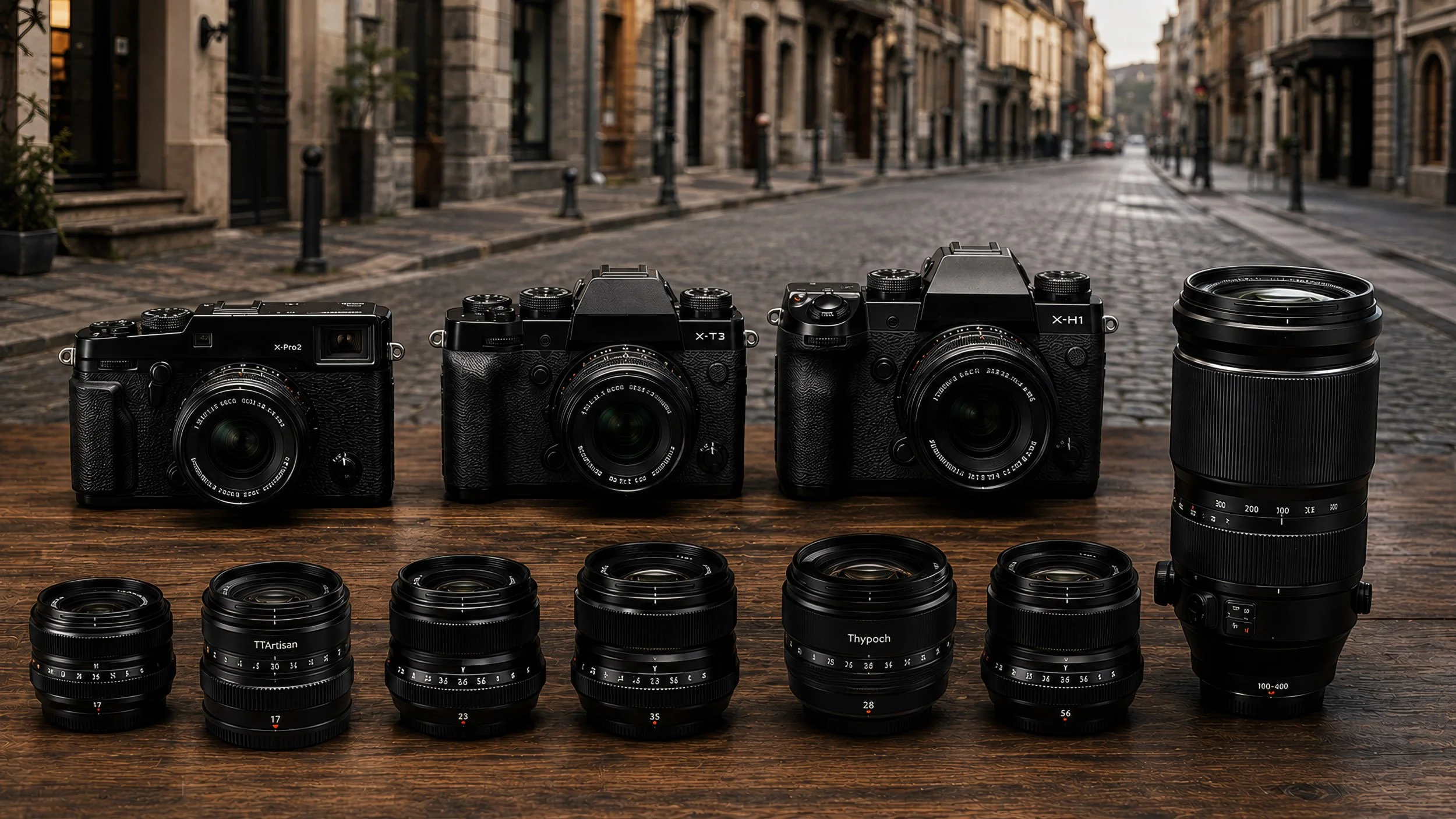
I regularly get asked questions about my photography gear. That is the reason I’ve compiled a list of my Fujifilm photography kit. I don’t usually emphasize the gear aspect of my photography, but I hope this is helpful to someone. I am not sponsored. All my gear was acquired with my own funds.
The cameras feel wonderfully direct: aperture, shutter speed and exposure are always within reach, without technology getting between me and the moment. I appreciate their compact and discreet character, especially when I disappear into the rhythm of the street with my X-Pro2, X-T3 or X-H1.
They allow me to be present without becoming too present. There is also something refreshingly photographic about Fujifilm — the cameras invite me to observe first and press the shutter second. With small prime lenses, they become an almost natural extension of my eye, while zooms give me the flexibility I need when a story develops unexpectedly. I can work intuitively, react quickly, or deliberately slow down and wait for the elements within the frame to come together.
Fujifilm cameras and lenses have a timeless, understated design that combines the character of classic photography with modern precision. The tactile dials, clean lines and beautifully matched lenses make the equipment feel less like electronics and more like carefully crafted photographic tools. There is an authenticity to their appearance that reflects what I love about photography itself: simplicity, craftsmanship and character.
Fujifilm gives me something more valuable than specifications: it gives me the freedom to photograph in my own way.
Daniel Milnor about Fujifilm
What makes his story particularly interesting is that it goes beyond specifications and technology. It is about the relationship between photographer, camera and subject — and how the right equipment can almost disappear while you are working. His thoughts strongly resonate with the way I approach my own street and documentary photography: travelling light, remaining unobtrusive and concentrating on observation, timing and human moments.
A thoughtful perspective on why sometimes the best camera is simply the one that gets out of your way and lets you see.
Fujifilm X-Pro2
The Fujifilm X-Pro2 is one of those cameras that seems almost purpose-built for street and documentary photography. Its compact, discreet rangefinder-style design allows me to move through a scene without the camera becoming the centre of attention. The unique hybrid viewfinder keeps me connected to what is happening both inside and just outside the frame — especially valuable when anticipating a decisive moment.
What I love most, however, is the way the X-Pro2 encourages me to slow down, observe and photograph with intention. Combined with a small prime lens, it becomes less like a piece of technology and more like a natural extension of the way I see. For my street photography and documentary projects, that combination of simplicity, discretion and tactile control makes the X-Pro2 a camera I genuinely enjoy carrying with me.
Fujifilm X-T3
The Fujifilm X-T3 combines the tactile character I appreciate in Fujifilm cameras with the speed and responsiveness I need when situations change quickly. Its traditional dials, compact body and excellent electronic viewfinder allow me to work intuitively, keeping my attention on the scene rather than the camera.
For street photography and documentary projects, I particularly value its fast autofocus, discreet operation and versatility. Where the X-Pro2 encourages me to slow down and anticipate, the X-T3 feels more responsive and spontaneous — ideal when movement, gestures and unexpected moments become part of the story. It is a camera that gives me the freedom to react quickly while still maintaining the deliberate way of seeing that defines my photography.
FUJIFILM VG-XT3 BATTERY GRIP
The Fujifilm X-H1 is the camera I reach for when I want the character of the Fujifilm system combined with a more solid, stable shooting experience. Its robust body, excellent ergonomics and in-body image stabilization make it particularly valuable when working handheld and experimenting with slower shutter speeds.
For my street and documentary photography but also for my sports photography, the X-H1 gives me the freedom to explore movement rather than simply freeze it. I can work creatively with motion blur, atmosphere and available light while still remaining mobile and responsive. It is a camera that invites experimentation — especially when I want to move beyond the decisive moment and show the feeling of time and movement within a single frame.
Fujifilm X-H1
The Fujifilm X-H1 is the camera I reach for when I want the character of the Fujifilm system combined with a more solid, stable shooting experience. Its robust body, excellent ergonomics and in-body image stabilization make it particularly valuable when working handheld and experimenting with slower shutter speeds.
For my street and documentary photography but also for my sports photography, the X-H1 gives me the freedom to explore movement rather than simply freeze it. I can work creatively with motion blur, atmosphere and available light while still remaining mobile and responsive. It is a camera that invites experimentation — especially when I want to move beyond the decisive moment and show the feeling of time and movement within a single frame.
FUJIFILM VPB-XH1 BATTERYGRIP
The Fujifilm X-H1 is the camera I reach for when I want the character of the Fujifilm system combined with a more solid, stable shooting experience. Its robust body, excellent ergonomics and in-body image stabilization make it particularly valuable when working handheld and experimenting with slower shutter speeds.
For my street and documentary photography but also for my sports photography, the X-H1 gives me the freedom to explore movement rather than simply freeze it. I can work creatively with motion blur, atmosphere and available light while still remaining mobile and responsive. It is a camera that invites experimentation — especially when I want to move beyond the decisive moment and show the feeling of time and movement within a single frame.
Lenses for my Fujifilm camera’s
For me, choosing a lens is not simply about focal length or technical perfection — it is about choosing how I want to see the world. That is why I enjoy combining my Fujifilm cameras with lenses from Fujinon, Thypoch and TTArtisan, each bringing its own character to my photography.
Fujinon gives me speed, reliability and versatility when I need to react instinctively to a moment. Thypoch takes me in another direction, encouraging a slower, more deliberate approach where manual focusing becomes part of the creative process. TTArtisan brings a playful sense of freedom to my photography, with compact and affordable lenses that invite experimentation. They encourage me to slow down, explore different perspectives and discover how simplicity can often lead to surprisingly creative images.
Sometimes I want the intimacy of a classic focal length; at other times, I want to step closer and allow the environment to become part of the story. I like lenses that do more than simply record what is in front of me — they should influence how I move, observe and compose.
Some help me capture the decisive moment, while others encourage me to wait, experiment or see a familiar scene differently. Together, these lenses give me a toolbox of perspectives rather than just a collection of focal lengths.
The camera records the photograph, but the lens often determines how I discover it.
Fujifilm XF 16mm f/1.4 R WR
The Fujifilm XF 16mm f/1.4 R WR has become a particularly interesting lens for the way I approach street photography. With its 24mm full-frame equivalent field of view, it encourages me to get close to the action while still showing enough of the surroundings to give the image context.
Rather than isolating a subject, the 16mm allows me to work with people, architecture, light and unexpected details within the same frame. That makes it especially suitable for layered compositions and storytelling on the street. The fast f/1.4 aperture is an additional advantage when working in low light or when I want to separate a nearby subject from the background.
It is not necessarily the easiest focal length for street photography. You have to move closer, pay attention to the edges of the frame and carefully control perspective. But that is precisely what makes this lens so rewarding: it encourages me to become part of the scene instead of observing it from a distance.
Fujinon 23mm f2.0 R RW
The Fujinon XF 23mm f/2 R WR is one of my most natural choices for street and documentary photography. On my Fujifilm cameras, its field of view is close to the classic 35mm perspective — wide enough to include the environment, yet intimate enough to keep people at the heart of the image.
Its compact size, fast autofocus and discreet appearance allow me to work quickly without drawing unnecessary attention. I particularly like the 23mm when I want to get close to the action and create a sense that the viewer is actually part of the scene.
For me, this lens represents what street photography is all about: being present, observing carefully and reacting instinctively when all the elements suddenly come together.
Fujinon 35mm f2.0 R RW
The Fujinon XF 35mm f/2 R WR is one of those lenses that feels perfectly at home on a Fujifilm camera. Its compact size, fast autofocus and discreet appearance make it an excellent choice for my street and documentary photography, where I want the camera to remain almost unnoticed.
Its field of view is close to the classic 50mm perspective, giving me a natural balance between subject and surroundings. It is wide enough to retain context, yet focused enough to isolate gestures, expressions and small human moments.
What I particularly appreciate is its simplicity and responsiveness. Combined with my X-Pro2 or X-T3, it creates a small and unobtrusive setup that allows me to concentrate on what really matters: observing, anticipating and capturing the moment without disturbing it.
Fujinon 56mm f1.2 WR
The Fujinon XF 56mm f/1.2 R WR is one of my favourite lenses when I want to create portraits with a strong sense of presence. Its short-telephoto perspective gives me a natural working distance, making it ideal for street portraits and portraits on location.
The fast f/1.2 aperture allows me to separate people beautifully from their surroundings while still retaining enough context to tell something about who they are and where they are. I especially value its combination of sharpness, soft background rendering and excellent performance in available light.
For me, this lens is not simply about creating beautiful background blur. It is about directing attention to the person, their expression and character, while allowing the environment to become a subtle part of their story.
Fujinon 18-55mm f2.8-F4
The Fujinon XF 18–55mm f/2.8–4 R LM OIS is one of those lenses that proves versatility does not have to come at the expense of character. Its compact size and useful focal range make it an ideal companion for my street and documentary photography, especially when I want to travel light and react quickly to changing situations.
From wider environmental scenes to more intimate portraits and details, the 18–55mm allows me to change perspective without interrupting the moment. Its optical stabilization is particularly useful when working handheld in available light or with slower shutter speeds.
What I value most is its freedom and simplicity. With one small lens on my camera, I can concentrate on observing people, anticipating moments and telling the story — rather than thinking about which lens I should use.
Fujinon 100-400mm f4-5.6 OIS WR
The Fujinon XF 100–400mm f/4.5–5.6 R LM OIS WR gives me the reach and flexibility I need when photographing sports from a distance. Its wide telephoto range allows me to quickly switch between a broader view of the action and tightly framed moments of emotion, concentration and physical intensity.
For my sports photography, I particularly value the combination of fast autofocus, effective optical stabilization and relatively manageable size. It allows me to follow unpredictable action while remaining mobile around the field or venue.
What I appreciate most is that the 100–400mm does more than simply bring the action closer. It allows me to isolate decisive moments from a visually busy environment, compress perspective and turn a fraction of a second into a powerful image of movement, energy and emotion.
Thypoch Simera 28mm f1.4
The Thypoch Simera 28mm f/1.4 brings a very different experience to my street photography. Its fully manual operation encourages me to slow down, anticipate what is about to happen and become more aware of distance, light and composition before pressing the shutter.
I particularly enjoy the 28mm perspective because it allows me to work close to people while still including enough of their surroundings to give the photograph context. The fast f/1.4 aperture adds another creative dimension, especially in low light or when I want to separate a subject from the urban background.
Combined with my Fujifilm X-Pro2, the Simera feels wonderfully direct and uncomplicated. It is less about technical perfection and more about the experience of seeing, anticipating and creating — exactly what I value in street and documentary photography.
Laowa 9mm f2.8 Zero-D C&D Dreamer
The Laowa 9mm f/2.8 Zero-D gives me a completely different perspective on the world. Its extreme wide-angle view allows me to work with space, architecture, strong foregrounds and dramatic compositions, while the Zero-D design helps keep distortion remarkably well controlled.
For my street, documentary and architectural photography, I especially enjoy using this lens when the environment itself becomes an important part of the story. It encourages me to get close, explore unusual viewpoints and create a strong relationship between people and the space around them.
As a manual-focus lens, it also fits the way I like to work: observing, anticipating and composing deliberately. The Laowa 9mm is not an everyday lens for me, but precisely because of its distinctive perspective, it can transform an ordinary scene into something unexpected and visually powerful.
TTArtisan 17mm f1.4
The TTArtisan 17mm f/1.4 is a compact manual-focus lens that encourages me to get close and become part of the scene. On my Fujifilm cameras, its wide perspective is ideal for street and documentary photography, where people and their surroundings often need to tell the story together.
The fast f/1.4 aperture gives me extra creative freedom in low light, while manual focusing makes the photographic process more deliberate. I particularly enjoy using zone focusing, allowing me to anticipate a moment rather than wait for autofocus.
For me, the 17mm is about proximity, context and spontaneity — a small lens that helps create photographs that make the viewer feel as if they were standing right there beside me.
TTArtisan 35mm F1.4
The TTArtisan 35mm f/1.4 offers a more intimate and focused way of working. On my Fujifilm cameras, its field of view is close to the classic 50mm perspective, making it ideal for street portraits, quieter observations and documentary moments where I want to concentrate on the human story.
Its f/1.4 aperture is particularly useful in low light and gives me the option to isolate a subject from a busy background. At the same time, the manual focus encourages a slower and more deliberate approach — observing first and photographing second.
I like the 35mm because of its simplicity and character. It removes unnecessary technology from the process and leaves me with the essentials: light, timing, composition and the person in front of my camera.
Fringer EF > FX Adapter
The Fringer EF–FX Pro Adapter is one of the most capable solutions for using Canon EF lenses on Fujifilm X-series cameras. For me, it provides an interesting bridge between my Canon and Fujifilm systems, allowing me to use some of my professional EF lenses on cameras such as the Fujifilm X-T3 and X-H1.
Unlike a simple mechanical adapter, the Fringer maintains electronic communication between camera and lens. It supports features such as autofocus, electronic aperture control, EXIF information and image stabilisation with compatible lenses.
One of the main strengths of the Fringer is its autofocus optimisation for a large number of Canon EF lenses. Compared with more basic EF-to-FX adapters, autofocus performance is generally faster and more reliable. AF-S works particularly well, while AF-C and subject tracking can also be surprisingly effective, although performance still depends on the specific camera and lens combination.
For moving subjects, the X-T3 is an especially interesting combination. Its autofocus system makes adapted Canon telephoto lenses potentially useful for sports and action photography, although I would still expect the most demanding situations to favour a native camera and lens combination.