Back Button Focus — Separating Focus from the Moment
For a long time, I focused the way most photographers do: half-press the shutter button, wait for the camera to focus, then press it completely to take the photograph. It works perfectly well — until you start photographing situations in which things happen quickly and unpredictably.
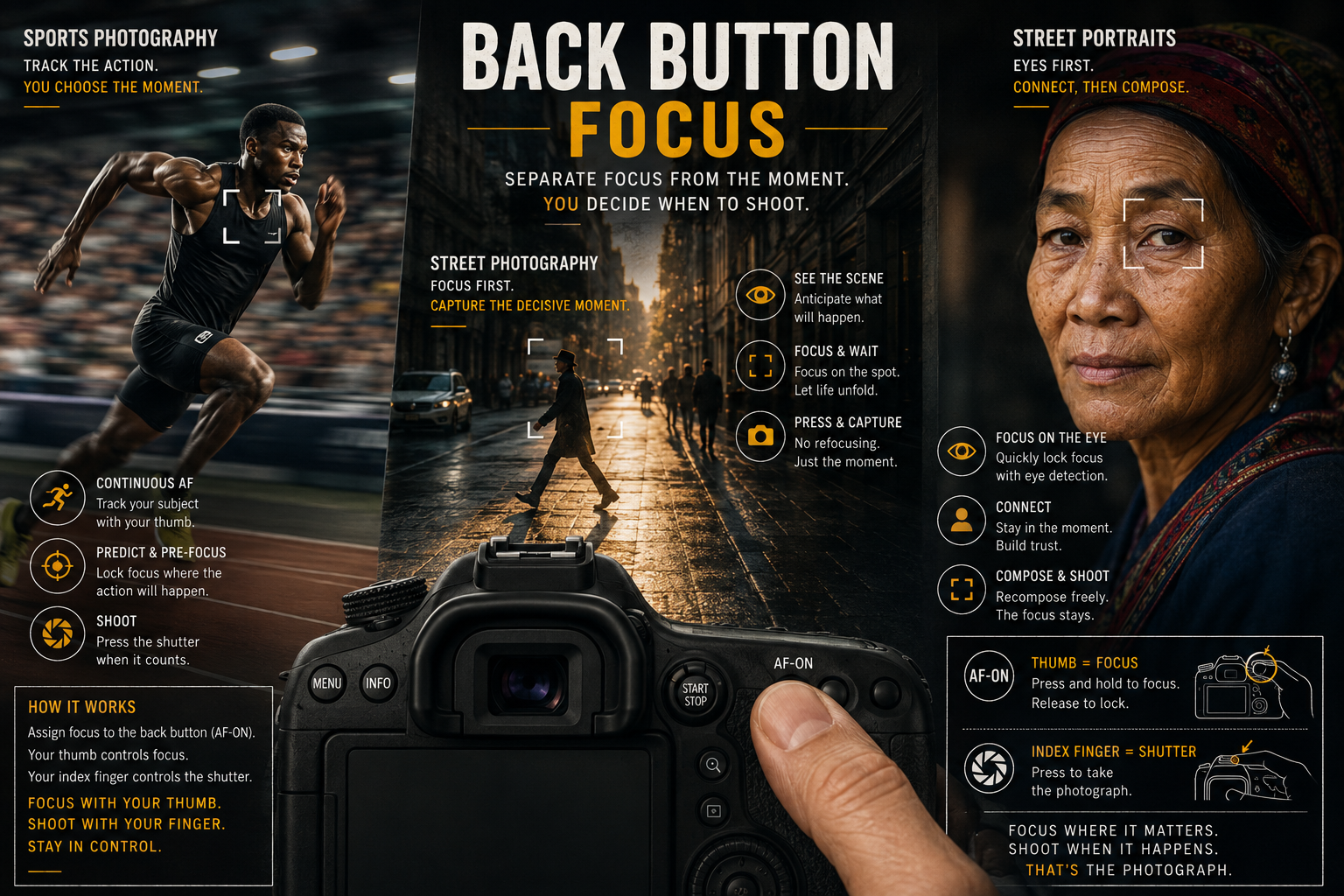
That is where Back Button Focus, or BBF, becomes interesting. The idea is very simple. Instead of using the shutter button for both focusing and taking the photograph, I separate those two functions. Autofocus is assigned to a button on the back of the camera, usually AF-ON, while the shutter button does only one thing: take the photograph. It sounds like a small technical change. In practice, it changes the way I work with the camera.
Focus first. Photograph second.
With BBF, my thumb controls autofocus and my index finger controls the decisive moment. Press the back button and the camera focuses. Keep it pressed and, when using continuous autofocus, it follows a moving subject. Release it and the focus remains where I left it. The important difference is that pressing the shutter no longer tells the camera to focus again. For me, that creates a clearer separation between two decisions:
Where do I want the focus? and When do I want to make the photograph? Those two decisions do not always happen at exactly the same moment.
Why I use BBF for sports photography
Sport is probably the most obvious application. An athlete can move towards me, away from me or suddenly change direction. With continuous autofocus and BBF, I can keep my thumb on AF-ON and let the camera track the athlete while my index finger is completely free to decide when to release the shutter.
But there is another advantage. Sometimes I know exactly where the important moment is going to happen. I can focus on that position beforehand, release the AF-ON button and wait. When the athlete enters the composition, I only have to press the shutter.
The camera doesn't need to make another decision. I have already made it. This is particularly useful when I am working with slower shutter speeds, panning or trying to create a more expressive image of movement. At that point I don't want to fight the autofocus system. I want to concentrate on timing, movement and composition.
BBF on the street
Street photography is different, but the principle is surprisingly similar. Very often I see the photograph before the photograph actually exists. I may notice an interesting background, a patch of light, a reflection or a strong composition and realise that what is missing is a person entering exactly the right place.
With BBF I can focus on that area beforehand and then simply wait. When someone enters the frame, pressing the shutter does not cause the camera to search for focus again. I can concentrate on gesture, position and timing. That fraction of a second can make the difference between a photograph that almost works and one where everything comes together.
And for street portraits?
For street portraits, BBF gives me another kind of freedom. With modern mirrorless cameras I often combine it with face or eye detection. I can quickly establish focus on the eye and then concentrate on the person rather than constantly thinking about the camera. This matters to me because a street portrait is not only about technical sharpness. It is also about contact.
I want to look at the person, observe an expression and notice small changes in posture. The less attention the camera demands, the more attention I can give to the person standing in front of me. BBF helps move the technical process into the background.
It takes some getting used to
There is one disadvantage: BBF initially feels strange. Years of photography create muscle memory. Your index finger automatically half-presses the shutter button expecting the camera to focus. Once that function is removed, you will probably make a few photographs that are completely out of focus simply because you forgot to use your thumb. That is normal.
My advice is not to switch continuously between the two methods. Configure one camera for BBF and use it consistently for a while. After some practice, your thumb starts finding the AF-ON button automatically. And that is exactly where you want to be.
The real advantage of Back Button Focus
For me, BBF is ultimately not about a button. It is about separating focus from timing. In sports photography, I can track movement or pre-focus on the place where the action will happen. In street photography, I can prepare my focus and wait for someone to complete the composition. And in street portraiture, I can establish focus quickly and return my attention to the person in front of me.
The camera becomes slightly less automatic — but I gain more control. And that fits the way I like to photograph. I don't want the camera to decide again at the very moment I have already decided.
Focus where the photograph might happen.
Watch what develops.
Press the shutter when it does.
Finding What Works for You
There is no single autofocus method that works perfectly for every photographer or every situation. Back Button Focus can be a powerful tool, but it is not a rule — and certainly not the only way to work. Sports photography, street photography and portraiture each demand something different, and even within those genres the circumstances can change from moment to moment. Experience will teach you when to track, when to pre-focus and when to simply trust the camera. In the end, the best autofocus setup is the one that feels natural, gives you confidence and allows you to react without thinking about the technology.
When focusing becomes instinctive, your attention can return to what really matters: seeing the photograph before the moment disappears.